Why We Built a Vertical AI for Outdoor Living
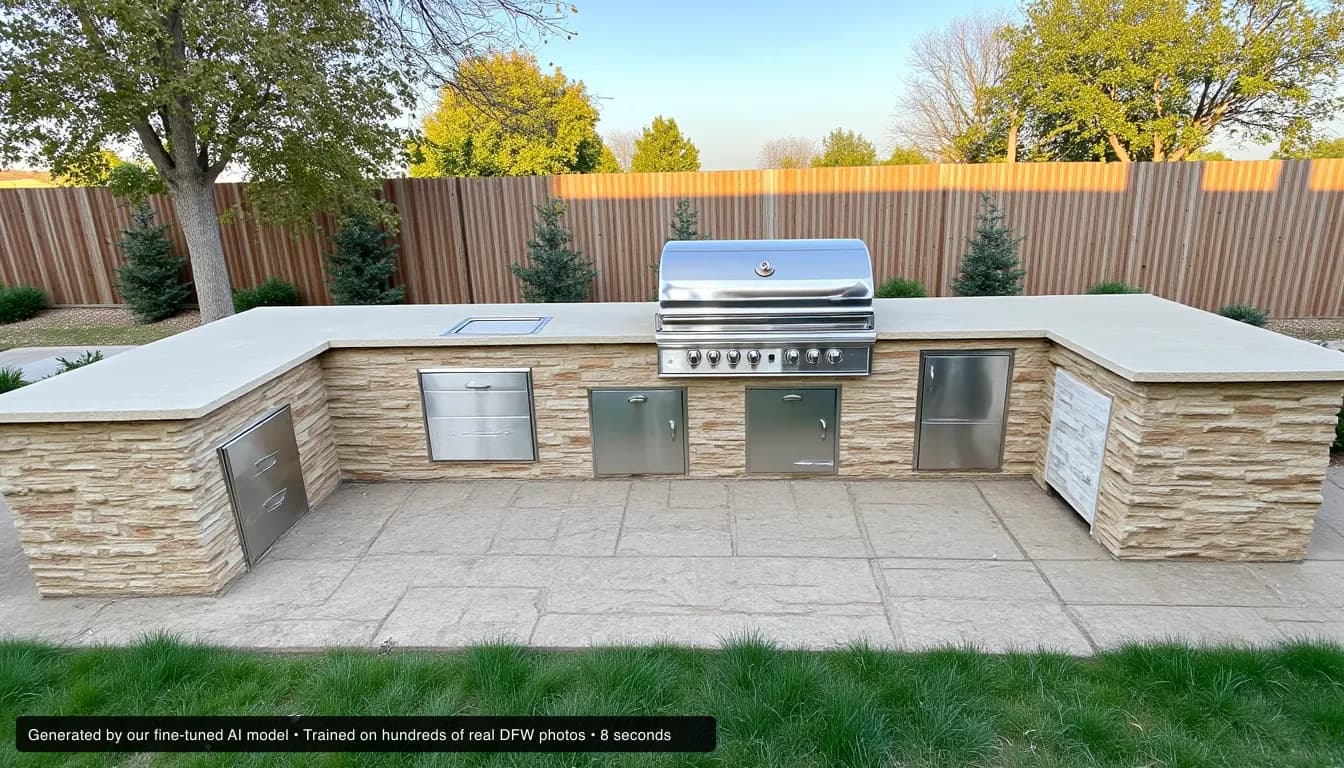
The image above was generated by our own fine-tuned AI model, trained on hundreds of real DFW outdoor kitchen photos. A visualization studio would charge $1,500+ and take weeks to deliver something like this. Ours takes 8 seconds and it's included in every estimate.
You can ask ChatGPT to estimate an outdoor kitchen. It'll give you a range so wide it's useless — somewhere between $5,000 and $50,000. Thanks for nothing.
That's the problem with general-purpose AI. It knows a little about everything and a lot about nothing. It doesn't know that Lueders Buff runs $325.50/ton at DFW wholesale. It doesn't know DFW labor rates shifted 12% since 2024. It doesn't know Keller requires structural engineering on retaining walls over 3 feet — not 4 like every other city in Tarrant County.
We do. And we built an AI that does too.
What "Vertical AI" Actually Means
Every general contractor has a front office — the salespeople, estimators, project managers, and office staff who handle pricing, scheduling, customer communication, and crew coordination. That front office typically adds 30-40% to your project cost before a single stone gets laid.
We replaced that entire front office with AI.
pAIsa does what a GC's office does — pricing, estimates, design guidance, material takeoffs, permit lookups, crew matching, and project tracking — but without the overhead. That means two things happen at once: homeowners pay less and the crews doing the actual work get paid more.
Here's what pAIsa handles:
- Pricing and estimates — 206 stones, 39 appliances, real DFW supplier costs. Not a range. A line-item breakdown in about 5 minutes.
- Design guidance — stone pairings, layout recommendations, aesthetic validation based on your home's exterior.
- Project prep — permit requirements for your specific city, material quantities down to mortar bags, supplier availability.
- Crew matching — connecting you directly to vetted sub crews who specialize in your project type and area.
- Project tracking — from signed proposal to final walkthrough, all in one place.
That's what vertical AI means. Not a chatbot. Not a lead gen site. A system that replaces the most expensive part of the construction process — the front office — and gives that value back to the homeowner and the crew.
When you tell pAIsa "I want a 16-foot L-shaped outdoor kitchen with Lueders Buff in Southlake," it doesn't guess. It calculates — stone tonnage, mortar bags, countertop slabs, appliance costs, labor, and permits. Every line item, transparent.
Why General AI Falls Short
General-purpose AI models are impressive. They can write poetry, debug code, and summarize research papers. But pricing a retaining wall in Fort Worth? They hallucinate.
Here's a real example. We asked a leading AI chatbot to price a 40-foot natural stone retaining wall, 4 feet tall, in Keller, TX. It said "$8,000 to $15,000."
The real number? $24,320. It missed the engineering requirement, underpriced the stone by 40%, and didn't account for the drainage core or mortar. A homeowner using that estimate would've been blindsided by a $10,000 gap.
pAIsa got it right because it was built to get it right. Every stone price, every labor rate, every city-specific permit rule is in the system — not inferred from internet averages.
How pAIsa Actually Solves This
Most AI products are a single model with a system prompt. pAIsa runs three specialized agents that work together on every estimate — each one solving a specific problem homeowners face.
The pricing problem: You call three contractors, get three wildly different numbers, and have no idea which one is real. pAIsa's Pricing Agent pulls actual material costs from DFW suppliers, calculates stone coverage using supplier rates (not a generic guess), and applies labor rates validated against real field data. You get one number, broken down line by line, that you can actually trust.
The design problem: You know you want an outdoor kitchen but you don't know which stone works with your house, what layout fits your yard, or whether that grill you saw on Instagram is worth the price. pAIsa's Design Agent recommends stones that complement your home's exterior, validates aesthetic choices, and suggests layouts based on your dimensions. It even warns you when a combination won't look right — like dark mortar on light stone pulling attention away from the stone itself.
The market problem: You have no idea if what you're being quoted is competitive or if you're getting taken. pAIsa's Social Agent tracks what DFW homeowners are actually building — trending materials, popular configurations, and the price points where people pull the trigger. Your estimate is grounded in what real people pay, not what contractors wish they could charge.
All three agents feed their data to Claude, which puts it together into a single conversation with a full line-item breakdown. No portal to log into. No PDF to wait for. Just a chat.
The Dirty Secret Nobody Talks About
Here's something homeowners don't know: residential construction is a gig economy.
That "established company" with the nice truck wrap and the five-star Google reviews? Most of them don't have their own crews. The night before your project starts, they're on Facebook groups posting "Need 3 guys for a kitchen build tomorrow in Keller, who's available?"
This isn't an exaggeration. It's how the industry works. Companies bid jobs, collect deposits, then scramble to find labor. Crews bounce between companies. Projects stall because the crew that started your kitchen left to finish someone else's job — usually because that other client was behind on payment and the crew walked.
When a project drags on for weeks past the deadline, it's rarely because the work is complex. It's because the company is juggling crews across multiple jobs, and yours isn't the one paying the most right now.
This is why we built pAIsa to cut out the middleman entirely. When you remove the GC's front office overhead, you can pay the crew more and still charge the homeowner less. The crew that shows up on day one is the crew that finishes — and they're getting paid fairly because there's no office taking 40% before they see a dollar.
What This Means for You
The old way: call three contractors, wait a week for each to show up, get three different numbers with no breakdown, pick one and hope for the best, then deal with surprise charges halfway through.
The pAIsa way:
- Know your price before you call anyone — a full line-item estimate in about 5 minutes, not 6 days of phone tag
- See where every dollar goes — stone per ton, labor per linear foot, mortar bags, appliances. Nothing hidden
- Get DFW-specific numbers — not national averages. Permit rules, supplier costs, and labor rates for your exact city
- Skip the middleman — connect directly with the crew doing the work, not a company that marks up 40% and scrambles for labor
- Track the whole project — from estimate to signed proposal to completion, all in one place
Why We're Sharing This
We're not hiding behind a black box. The outdoor living industry has operated on opacity for decades — vague quotes, hidden margins, surprise change orders. We think homeowners deserve better.
pAIsa is our answer: a vertical AI that replaces the GC's front office, gives homeowners full transparency on pricing, and connects them directly to the crews who do the work.
Try it yourself at paisalocal.com. Tell pAIsa what you want to build. See every line item. Then decide if you want to move forward — no pressure, no salespeople, no commitments.
---
Oscar Perales is the founder of PaisaLocal. Before building AI, he ran outdoor construction crews across DFW for over 20 years.