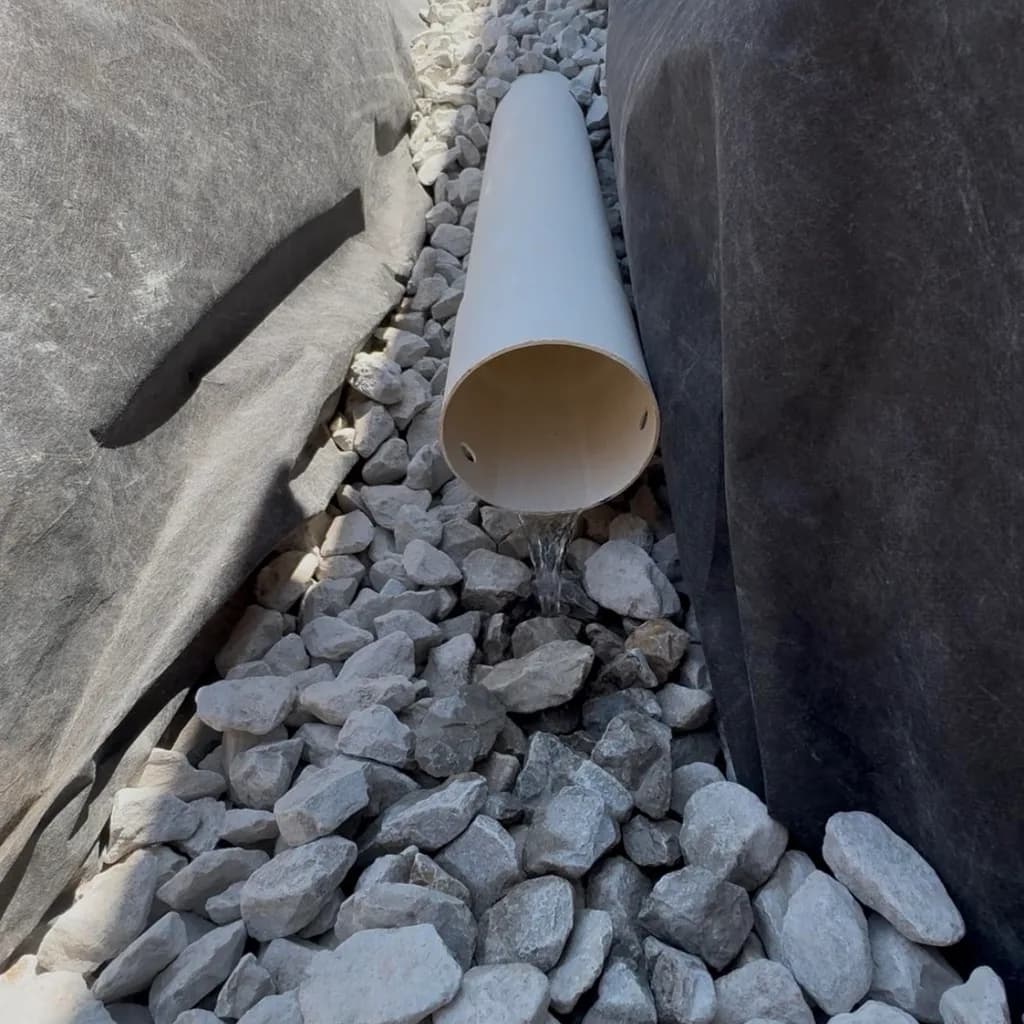
A French drain costs $60 per linear foot installed across Dallas–Fort Worth, plus $240 per catch basin. A typical 60-foot run with one basin comes to $3,840.
That's an all-in number — pipe, gravel, fabric, labor, and haul-off — not a materials price you still have to add labor to. Here's the full cost by length, what the $60 actually buys, and the cases where a drain is the wrong call.
French Drain Cost by Length
| Drain Run | Drain Only | + 1 Catch Basin | + 2 Catch Basins |
|---|---|---|---|
| 20 LF (minimum) | $1,200 | $1,440 | $1,680 |
| 40 LF | $2,400 | $2,640 | $2,880 |
| 60 LF (typical) | $3,600 | $3,840 | $4,080 |
| 80 LF | $4,800 | $5,040 | $5,280 |
| 100 LF | $6,000 | $6,240 | $6,480 |
| 150 LF | $9,000 | $9,240 | $9,480 |
The rate is flat at $60/LF — it doesn't drop on long runs the way concrete does, because the trench work scales linearly. A 40-foot side-yard run and a 150-foot wrap-around cost the same per foot.
Minimum job: 20 linear feet. Below that, mobilization costs more than the drain, and the honest answer is usually a downspout extension instead.
What the $60 per Linear Foot Includes
Every foot of drain run includes:
- Trench excavation to depth, in DFW clay
- Perforated pipe with a filter sock
- Filter fabric lining the trench so clay can't migrate into the gravel
- Washed gravel backfill — the part that actually moves water
- A daylighted outlet or tie-in, so the water has somewhere to go
- Spoil haul-off and cleanup
Catch basins are the one separate line item at $240 each installed. Those are the grated boxes that collect surface water at a low spot and feed it into the pipe.
Why DFW Yards Flood in the First Place
Dallas–Fort Worth sits on Blackland Prairie clay. Clay doesn't drain — it swells when wet and shrinks when dry, and water that lands on it has almost nowhere to infiltrate. So it sits.
That's why a yard that drained fine for ten years suddenly ponds: the grade settled a half-inch, and on clay a half-inch is enough to stop the water from leaving. It's also why "wait and see if it dries out" is a worse plan here than it would be on sand or loam. Standing water against a slab means the clay next to your foundation is going through a swell-and-shrink cycle every time it rains.
A French drain doesn't fix the clay. It gives the water a path of least resistance so it leaves before the clay has time to move.
Do You Need Catch Basins?
Not always. The drain line handles water moving through the soil. A catch basin handles water sitting on top of it.
Add basins when:
- There's a visible low spot or bird bath that ponds after rain
- Downspouts need to tie directly into the drain line
- The run is long enough that you want a mid-line cleanout access point
A straight side-yard interceptor with a good fall often needs zero basins. A back yard with two ponding spots and three downspouts usually wants two.
French Drain vs the Other Drainage Fixes
| Fix | What it solves | Our 2026 DFW cost |
|---|---|---|
| Downspout extension | Roof water dumping at the slab | Often DIY — not a drain job |
| Surface drain + basin | One ponding low spot | $240 per basin, tied to a run |
| French drain | Saturated soil, slow-draining yard, water against the slab | $60/LF |
| Regrading | Wrong slope over a large area | Site-specific |
Order of operations matters. If the water is coming from a downspout emptying two feet from your foundation, extend the downspout first — that's a cheap fix, and it may be the whole problem. A drain is for yards where the water has nowhere to go even after the obvious sources are handled.
When a French Drain Is the Wrong Call
Three cases where we'll tell you not to buy one:
1. There's no outlet. A drain is a path, and a path needs a destination — a lower grade, a street, an alley, a swale. If your yard is the low point of the block with nowhere downhill, a drain pipe just relocates the puddle. That's a grading or sump conversation. 2. The real problem is one downspout. See above. We'd rather tell you to spend $40 at the hardware store than $1,440 with us. 3. You're seeing foundation movement, not yard water. Cracks, sticking doors, and separating brick are a structural evaluation first. Drainage is part of the long-term answer, but it isn't the diagnosis.
How pAIsa Prices Your Drain
You don't need a contractor to walk your yard before you see a number.
Pick the French drain card, type your address, and measure the run on the satellite view — trace the path you want the drain to take, segment by segment, and pAIsa sums the linear feet and prices it against the same 2026 rates in this article. Add catch basins and the total updates.
What you get back is an itemized estimate, not a range: linear feet, basins, and the all-in total. If you move forward, a crew lead confirms the measurements and the outlet on site, and the work is billed on milestones rather than one lump deposit.
Price your French drain now — or read the full DFW French drain service page for scope and coverage area.
FAQ
How much does a French drain cost in DFW?
$60 per linear foot installed, all in. A 40-foot run is $2,400, a 60-foot run is $3,600, and a 100-foot run is $6,000. Catch basins are $240 each. Minimum job is 20 linear feet.How much does a 100-foot French drain cost?
$6,000 at $60 per linear foot. With two catch basins it's $6,480. That's the installed price including pipe, filter sock, fabric, washed gravel, outlet, and haul-off.What does the French drain price include?
Trench excavation, perforated pipe with a filter sock, filter fabric, washed gravel backfill, a daylighted outlet or tie-in, and spoil haul-off. Catch basins are the only separate line item at $240 each.Is $60 per linear foot a good price for a French drain in Texas?
It's our flat 2026 DFW rate, and it's an all-in number. Be careful comparing it to quotes that price materials and labor separately, or that exclude the outlet — the outlet is the part that makes the drain work, and it's the most common thing left off a cheap bid.How deep should a French drain be in clay soil?
Deep enough to intercept the water and still maintain fall to the outlet. In DFW clay, depth is driven by where the water is sitting and how much slope you have to work with, so it's set on site rather than from a formula. The $60/LF rate covers the excavation either way.Do I need a permit for a French drain in DFW?
Residential yard drainage generally doesn't require a permit the way a slab or a retaining wall does, but tie-ins to a street, alley, or storm system are city-specific. We check your city's rule before the crew digs.Will a French drain fix water against my foundation?
It's the standard fix for soil that stays saturated next to a slab, and getting water away from the foundation is exactly what it's for. But if you're already seeing cracks, sticking doors, or separating brick, get a structural evaluation first — drainage is part of the long-term answer, not the diagnosis.How long does a French drain take to install?
Most residential runs are a one-to-two-day job. Length, access, and whether the crew is working around existing hardscape or irrigation drive the schedule more than linear feet alone.Can I just regrade instead of installing a drain?
Sometimes. Regrading works when the slope is wrong across a large open area and there's somewhere for the water to go. A drain is the better answer when the problem is localized, when hardscape blocks the grade, or when the yard is flat with no fall to work with.---
Rate source: $60 per linear foot and $240 per catch basin are PaisaLocal's 2026 Dallas–Fort Worth field rates, read directly from the same pricing service that generates live estimates at paisalocal.com. Minimum job 20 linear feet. Updated October 2026.
Related: retaining wall cost per linear foot in DFW — drainage behind a wall is what keeps it standing. And concrete patio and retaining wall permits in DFW if your drainage project touches hardscape.